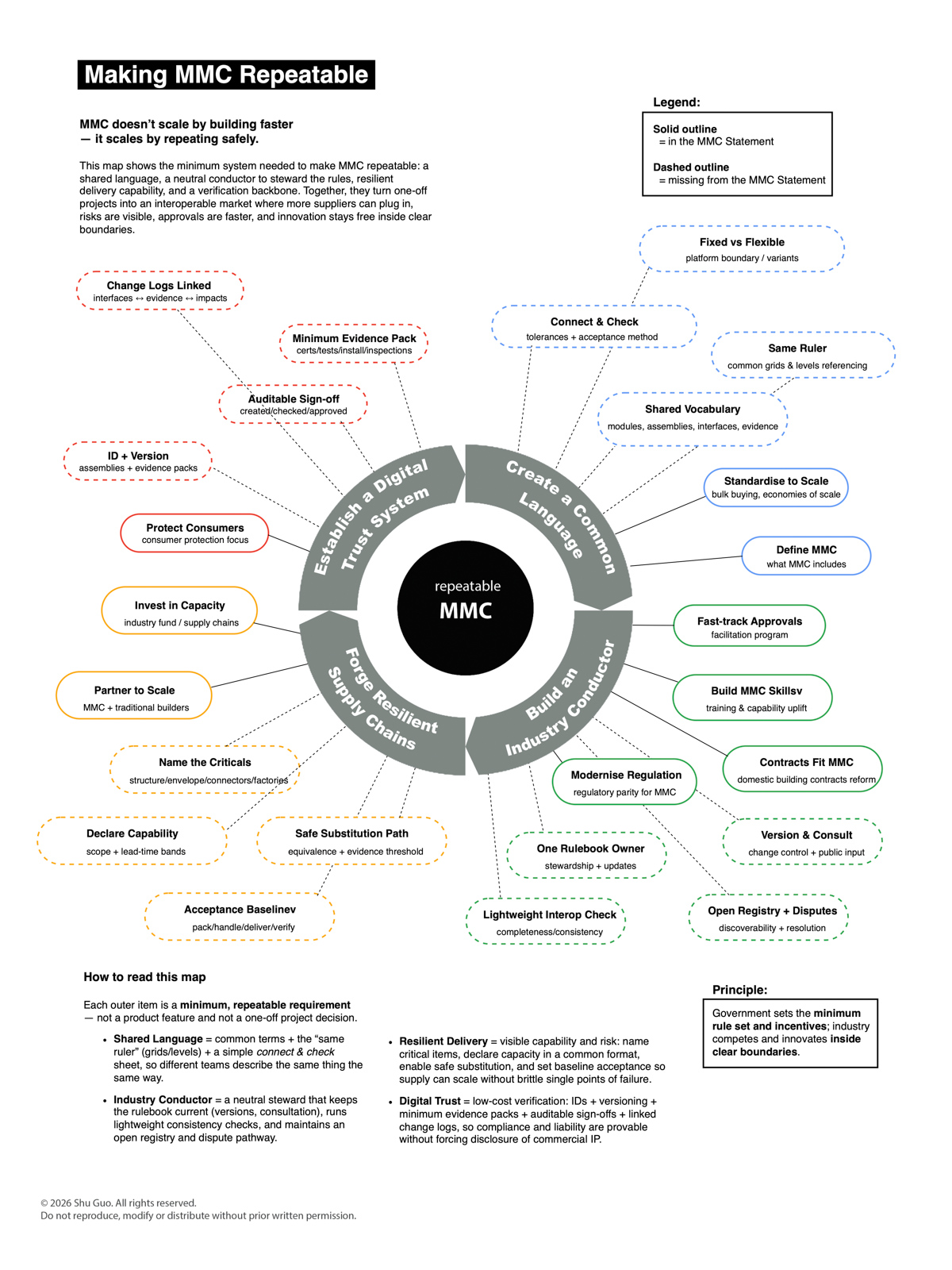
This framework diagram distils a simple but often misunderstood point:
MMC does not scale by building faster.
It scales by repeating safely.
In many public discussions, MMC is still framed as a productivity shortcut — a way to move work off-site, reduce labour, and accelerate delivery. That is only part of the story.
Speed alone does not create a repeatable system.
A factory can produce quickly and still fail to scale if approvals are inconsistent, interfaces are ambiguous, substitution paths are unclear, liability is hard to trace, or each project has to reinvent its own delivery logic from scratch.
What allows MMC to scale is not merely manufacturing efficiency, but the creation of a minimum repeatable system.
This diagram maps that minimum system through four linked conditions:
- Create a Common Language — so different teams describe the same thing in the same way
- Build an Industry Conductor — so the rulebook is stewarded, updated, and interpreted consistently
- Forge Resilient Supply Chains — so capability, substitution, and acceptance can scale without brittle failure points
- Establish a Digital Trust System — so evidence, sign-off, versioning, and accountability remain visible and auditable
The coloured solid outlines mark what is already present in the Victorian MMC Statement.
The dashed outlines mark what is still missing if MMC is to become genuinely repeatable across projects rather than selectively successful in isolated pilots.
The point is not that every project needs more complexity.
It is the opposite.
A repeatable industry needs fewer one-off decisions, not more.
That means shared terms. Clear boundaries. Visible evidence. Named responsibility. And a neutral governance layer strong enough to hold consistency without suppressing innovation.
In that sense, the real task is not simply to promote MMC.
It is to make MMC legible, verifiable, and safely repeatable.
Further Reading
For the longer essay behind this diagram, see "What’s Missing in Victoria’s MMC Statement".