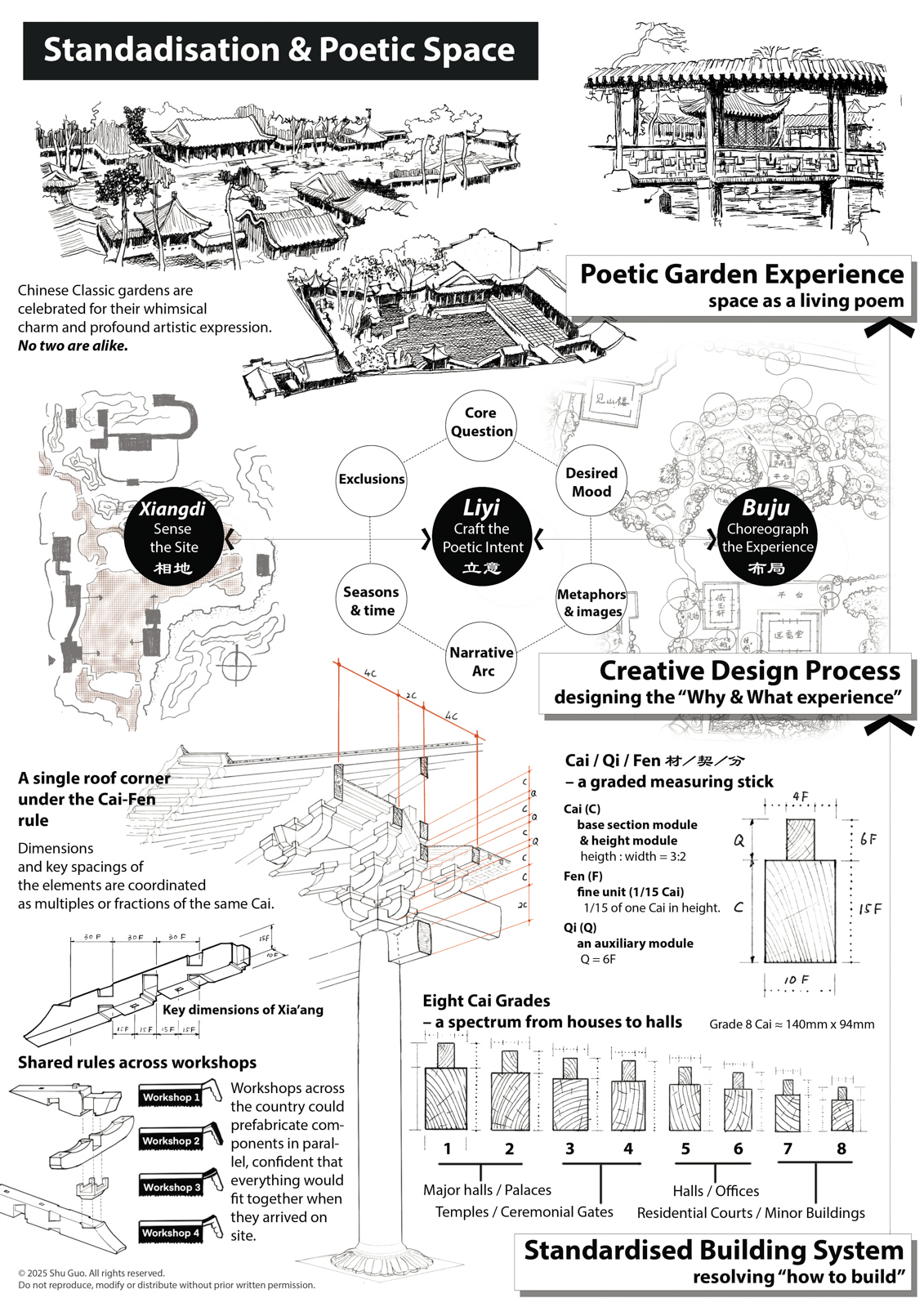
This framework diagram condenses a core argument that runs through much of my work:
standardisation does not eliminate poetry in architecture.
It is often the very condition that makes poetic space possible.
In many contemporary discussions, standardisation is treated as the enemy of design freedom — associated with repetition, monotony, and loss of individuality. But history suggests something more subtle.
Classical architecture and gardens offer a different model. Beneath their extraordinary variety lies a deeply shared system of rules: proportional logics, dimensional hierarchies, modular relationships, and workshop-compatible construction methods. The Cai–Qi–Fen system did not prescribe identical outcomes. It created a reliable framework within which difference, atmosphere, and spatial drama could emerge.
This diagram proposes a three-part reading:
- Standardised Building System — shared rules resolve how to build
- Creative Design Process — design intent defines what experience to create
- Poetic Garden Experience — the built result becomes space as a living poem
The central claim is simple but consequential:
When the technical system is stable enough, design can become more—not less—free.
In that sense, standardisation is not the opposite of expression.
At its best, it is the hidden discipline that allows singular experience to appear.
Further Reading
For the full argument behind this diagram, see: "Why Standardisation Can Liberate Design".